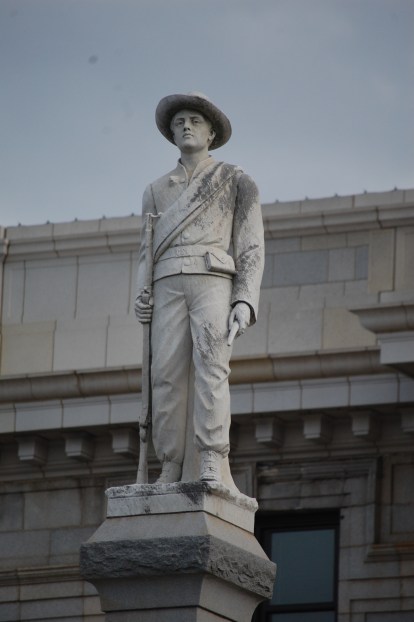
 This afternoon, Evie Terrono and I co-presented a paper at the College Art Association’s annual meeting titled “Monuments in Crisis: Debates on the Confederate Landscape.” Focusing on the recent controversy regarding the future of Confederate monuments, we debated the monuments’ meaning and possible next steps for communities interested in recontextualizing or removing them. While I argued the iconoclast’s perspective, Evie counseled caution, noting the monuments’ value as works of art and as multivalent objections symbolizing the nation’s checkered past.
Our paper was part of Public Art Dialogue‘s session, “Teachable Monuments: Using Public Art to Spark Dialogue and Address Controversies, ” part of PAD’s larger Teachable Monuments initiative. With the idea of the “teachable” in mind, we decided to end our paper with a series of suggestions for art historians to intervene in community conversations surrounding the future of contested monuments. The following is based on the concluding section of our paper.
We are both in agreement that ongoing debates about the fate of the monumental landscape provide unique opportunities for art historians to intervene. Whether the ultimate goal is to remove problematic monuments from view or to preserve them in some way, there are several steps that you, the civically-minded art historian, can take right now to make your voice heard: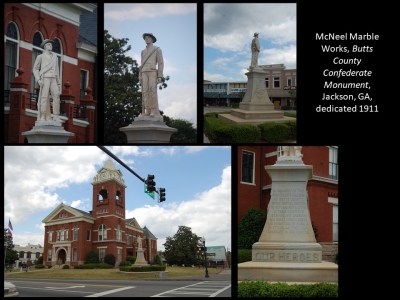
- Document your local monuments: Record the monuments in the town where you live, whether they are Confederate monuments or otherwise, in order to preserve the record for the future. Photograph monuments from all angles, including details, inscriptions, and long views, and the surrounding landscape. Document vandalism, damage, or if the monuments are removed, the process of their removal. Research your local monuments in libraries or archives, and learn about their history. The memorial landscape may be changing, and we may not all be in agreement about how or whether to slow that process. But if we can document the landscape the way it appears now, at least we will be able to pass down that photographic record to future researchers.
- Get involved in discussions in your community: If a monument near you is challenged, make your voice heard as your community debates its fate. Go to town hall meetings, and share your expertise as art historians. If there are protests, go to them and talk to the protestors who show up. Collect their literature and ask to photograph their signs. Current civic engagement is part of a monument’s afterlife – ephemeral action around a seemingly permanent object – and all of it inscribes new meaning onto the work of art. If a protest is happening in your community, your expertise as a researcher and scholar is crucial both for your community’s decision-making process and for the future historical record.
- Get the word out: You have a voice – use it. If you don’t have a Twitter account yet, make one. Start a blog. Make a professional website listing your qualifications. Apply to be listed as an expert on public art in databases such as Expert Finder or SheSource. Talk to the media. Write op-eds, open letters, and petitions. Give public presentations to general audiences, not just at academic conferences. Contribute to crowdsourced syllabi gathering information on the history of public monuments. As an art historian or public scholar, your opinion is valuable to the public discourse.
At a time when government funding for the humanities is perpetually in jeopardy, and the future of the tenure track in academia is uncertain, the Confederate monument crisis is a clear illustration of why our discipline is culturally vital and necessary. It is important that we all take this opportunity to define ourselves as public scholars and to make our skills and knowledge available to our communities as they grapple with the future of problematic monuments.
 Yesterday was “one of those days” in the life of a professor/parent/public historian: I took a rare Saturday trip down to Philadelphia to do some reconnaissance for a paper assignment for my students at the
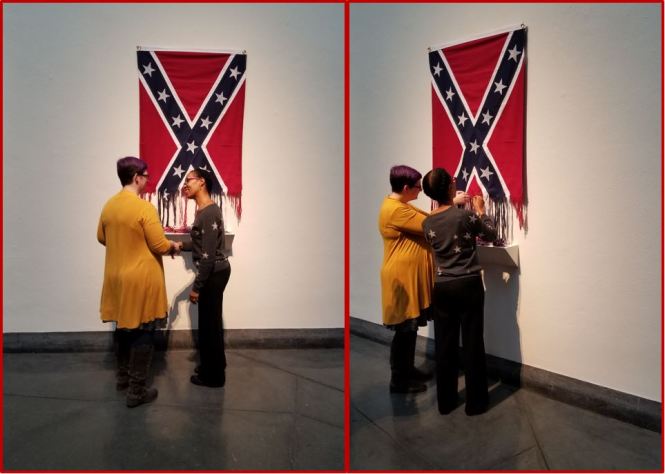
 I had a sense of the unraveling as a community effort to pull down barriers and restore peace. When my turn came, I found comfort in Clark’s warm and reassuring presence as she pointed out some tiny threads along one of the flag’s white stripes for me to pull. I have a feeling I will take that memory with me as I continue to play my part in dissolving the Confederate legacy. Not all revolutions are fought in the streets with weapons and shouting. They can also happen between individuals in a quiet gallery on a Saturday afternoon.
 October is always a busy month, both personally and professionally. The semester is in full swing, with fresh lesson planning every week, and grading usually begins to pile up. It’s the best month of fall and the season of my favorite holiday, Halloween, which means haunted houses and corn mazes on the weekend (this year, the
 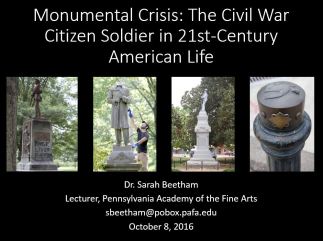 One of the best things about attending an academic conference is the way it can reinvigorate your commitment to your own work. Lately, I’ve been very consumed with teaching and lesson planning, and my research has been on something of a back burner. But in the leadup to AHAA, I pulled myself together to present “Monumental Crisis: The Civil War Citizen Soldier in 21st-Century American Life,” an overview of my current book project on the ways in which Civil War monuments are impacted by intentional vandalism or iconoclasm; deliberate revision or removal; accidental damage; and the effects of weather or neglect. I received a lot of helpful and encouraging feedback, and I feel a renewed sense of energy to continue developing this project. Hopefully I’ll have a lot more to report soon!
 For this year’s iteration of SECAC, I applied to chair a session titled “The Afterlives of Objects: Impermanence in American Art.” The response to the call for papers was quite robust, and so I asked the SECAC organizers about the possibility of a double session, which they granted (thanks to Jennifer Van Horn for stepping up to chair the second session!). Over the course of two sessions on Friday morning, we discussed both mob-led and artist-directed iconoclasm, recontextualization of public monuments, removal and destruction of works of art, conservation, entropy, and neglect. The sessions were well attended and the conversation afterward was quite lively. I was very pleased at how well the speakers’ individual topics dovetailed with one another, and I left SECAC with several pages of notes and new ideas. I always find SECAC to be one of the friendliest art history conferences out there, and the organizers do a great job nurturing young scholars and providing space for first-time panel chairs proposing their new ideas for discussion. Looking forward to next year’s conference in Columbus, Ohio!
 On the drive home from SECAC, I decided to make a stop at Washington and Lee University in Lexington, Virginia, to visit the Lee Chapel, burial site of Robert E. Lee. As I was driving down to Roanoke in total darkness last Thursday night, passing through the Shenandoah Valley on Route 81, I noticed that I was passing signs for one Civil War-themed site after another. Of course this makes sense, as the Shenandoah Valley was the site of fierce fighting throughout the war. But I don’t tend to find myself in this part of Virginia too often, and so I decided to use this trip to stop at one site that has been on my mind for some time. The Lee Chapel is the home of a recumbent sculpture of Robert E. Lee by Edward V. Valentine, unveiled in 1883. After Lee’s death in 1870, his wife, Mary Custis Lee, selected the Lee Chapel at the university where he had served as president as his final resting place. Eventually, the chapel became a burial vault for many members of the Lee and Custis families, and a pilgrimage site for Southern heritage tours.
 After knowing this statue from photographs and building it up in my head over so many years, I found the experience of it in person to be a bit of a letdown. Something about the marble seemed almost too clean, too starkly white, to the point that the more delicate details of the monument felt washed out. I’m not sure whether it was the lighting in the chapel, the disconnect between the sculpture and the surrounding space, or the “fish out of water” feeling that often comes over me when I visit a site that overtly reveres the Confederacy, but viewing this sculpture made me supremely uneasy. So, partly to soothe this uneasiness, and partly to let the old man know that not everyone who visits his grave approves of his legacy, I hummed a verse and chorus of “The Battle Cry of Freedom” under my breath:
 Outside the Lee Chapel, I found another Civil War oddity that has long amused me: the grave of Lee’s horse, Traveller. After Traveller’s death in 1871, he was first buried on the grounds of Washington and Lee University, but then exhumed around 1875, and his bones were bleached and mounted for display. But during their time on display, they were often vandalized by students carving initials into them, and so finally Traveller was laid to rest beside the Lee Chapel in 1971. Visitors sometimes leave carrots at his grave; I was unable to find any before my impromptu visit to Lexington. This is not the only weird site associated with a Civil War horse, and someday I’d like to visit them all.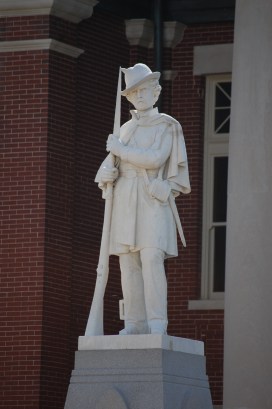
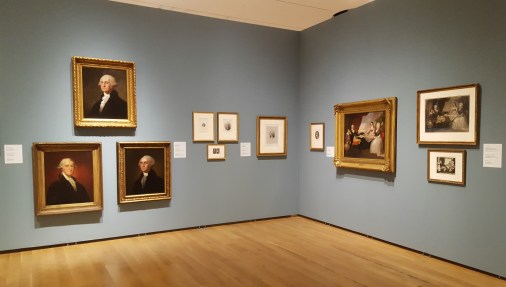 Yesterday, I took a trip down to Philadelphia to film a video promotion for my recent article in Public Art Dialogue on
 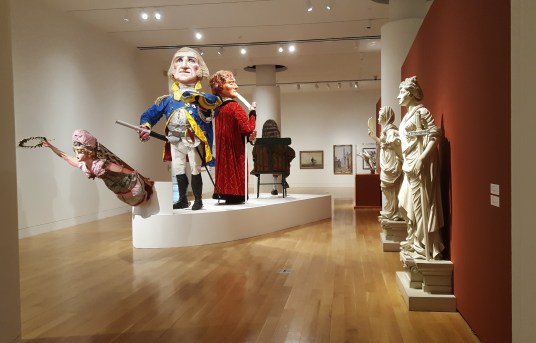 Walking into the show, the visitor immediately encounters a fun pairing of old and new: four colossal figures from Red Grooms’ 1982 Philadelphia Cornucopia, placed alongside wooden statues of Wisdom and Justice carved by William Rush c. 1824. Both of these artists created these pieces in a celebratory atmosphere: Rush carved his statues to adorn a Grand Civic Arch in honor of the Marquis de Lafayette’s 1824 visit to Philadelphia, while Grooms conceived his enormous Cornucopia, originally a much larger installation with myriad sculpted forms, for the city of Philadelphia’s 300th anniversary. In preparation for this exhibit at PAFA, the figures of George Washington, Martha Washington, Thomas Jefferson, and Benjamin Franklin were
  That opening salvo paves the way for a series of gallery spaces that focus on political figures, satirical cartoons, civil rights, and protest. Many viewers will be familiar with the famous representations displayed along the “Wall of Washington,” which offers views of the first President in painting and print slyly interspersed with offerings by contemporary artist
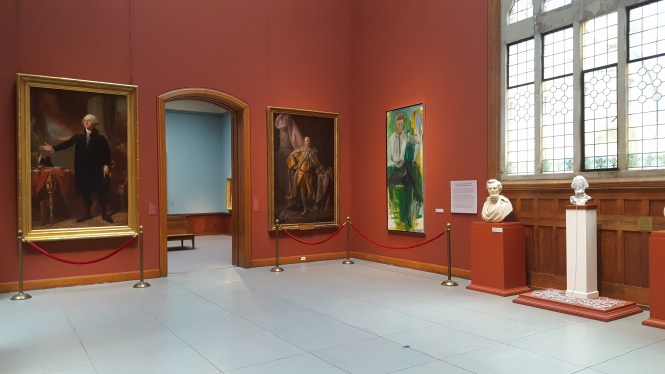
 Happiness, Liberty, Life? will be on display at PAFA through September 18, and you should check it out if you’re anywhere near Philadelphia. And on the way out, don’t miss the photo opportunity to take on the role of George Washington in Gilbert Stuart’s Lansdowne Portrait!
 few blocks away from PAFA, the All Wars Memorial to Colored Soldiers and Sailors, designed by J. Otto Schweizer and dedicated in 1934, may end up on my list of field trips. Based on my brief visit yesterday (the temperatures were over 90 degrees and I was worn out by the hot sun!) the memorial appears to depict several African-American soldiers in World War I uniforms clustered around an allegorical figure holding two wreaths. As is common with soldiers’ and sailors’ monuments, the soldiers depicted appear to represent the various branches of the armed forces who participated in the war. Plaques on the sides of the monument recognize the soldiers of the American Revolution, the Indian Wars, the Civil War, the Spanish-American War, the Philippine-American War, and World War I. There is definitely more to this story, and I look forward to figuring it out as I plan my fall syllabus. All in all, a stimulating trip to Philadelphia!
 Sarah Beetham, Ph.D.