A few weeks ago, I received an invitation to talk about my research on Civil War monuments with Larry Mendte on “The Delaware Way,” a weekly news program that airs on KJWP2 in Wilmington and covers Delaware news. The producers had seen Chris Carola’s article on soldier monuments, for which I was interviewed, and thought it would make a good segment for the show. We taped on Tuesday, May 12. I was pretty nervous when I arrived at the studio for the taping, but everyone treated me wonderfully and I had a great experience. The segment aired over the weekend, and now I am glad to share it.
It was a little bittersweet to receive the YouTube clip of the interview on a day when Gov. Nikki Haley called for the removal of the Confederate flag from the lawn of the state house in Columbia, S.C. and news reports surfaced that a Confederate monument in Charleston was tagged with the slogan “Black Lives Matter.” Today’s events have reminded me once again of how Civil War history and monuments remain a current part of our culture, implicated in the thorniest political issues of today. I hope to post about these developments further later in the week.
The latest issue of Nierika: Revista de Estudios de Arte is now out, and it includes an article I wrote on the replication of stock soldier figures in the wake of the Civil War! The article is part of a special section in the new issue organized by Amanda Douberley and me addressing the ways in which sculpture is copied, multiplied, and replicated. Based on a panel we organized at the 2013 Southeastern College Art Conference (SECAC), “Sculpture’s Multiples,” the issue examines the ways in which exact multiples of sculpture can be produced through mechanical means and the implications these processes have on the theme of originality in art. The three essays are by Amanda Douberley, Leda Cempellin, and me, and they explore the changing attitudes toward replication and originality in sculpture in the nineteenth and twentieth centuries.
My essay is titled “’An Army of Bronze Simulacra’: The Copied Soldier Monument and the
American Civil War,” and the abstract is below:
In the wake of the American Civil War, memorials to citizen soldiers who died during the conflict proliferated across the national landscape. Many of these monuments were replicated over and over using available mechanical processes to reproduce sculpture. Critics often complained that the monuments lacked originality or failed to memorialize the soldier properly. But the very formal sameness of the soldier monuments contributed to their effectiveness, connecting the statues to nineteenth-century popular culture with a visual repetition that linked local trauma with national memory. Ultimately, the soldier monument’s repetitive mimetic qualities made it a highly recognizable and legible form that continues to telegraph the enormous human cost of the Civil War.
Citation: Sarah Beetham, “‘An Army of Bronze Simulacra’: The Copied Soldier Monument and the American Civil War.” Nierika: Revista de Estudios de Arte 4, no. 7 (January-June 2015): 34-45.
Since the beginning of 2015, I have been solicited to write reviews of four recent books on American sculpture and monuments. Before this year, I had never received an invitation to write a review before, and I imagine the increase in requests might be related to my recent graduation from the University of Delaware. I have accepted all four requests, and at times I have been unsure whether this is the right step at this point in my career – for instance, Karen Kelsky of The Professor Is In has suggested that early career scholars should not write book reviews at all. Certainly, I am (and should be!) spending much of this summer focused on my own research and writing projects.
But despite Kelsky’s excellent advice, I have found the process of writing book reviews quite enjoyable and rewarding for my personal growth. First of all, all of these books are closely related to my field of research, and as I work on my book, I am happy to keep abreast of the important work going on around me. Many of them are by scholars I have long respected, and I enjoy keeping up with their work. Along with this, I am glad to have the incentive to devote time to reading in my field, a pleasure that is sometimes lost in the pressures of research and teaching obligations. And the process has proved useful for my teaching portfolio as well, as I have encountered readings and ideas that will appear on future syllabi.
In addition, as I begin to consider shopping my own book to publishers, I am thinking about the materiality of books and the work of university presses in a way that was not as much on my mind when I was a graduate student studying for comprehensive exams. And I certainly enjoy receiving a free book from time to time!
All in all, while this activity may or may not have an impact on my search for permanent employment or an eventual case for tenure, I have found it deeply rewarding and useful for my growth as a scholar and educator. For now, that is enough for me.
While I was organizing my workspace for summer writing this afternoon, I came across a clipping of a cartoon from the Bizarro strip by Dan Piraro, which originally ran on March 15, 2015:
From “Bizarro,” by Dan Piraro, March 15, 2015
Made me chuckle all over again! My favorite thing about the cartoon is that the figures sitting on the pigeon are all the sorts that would appear on soldier monuments – this really speaks to the way in which these statues have become “part of the furniture” in a way, mostly not recognized in our day to day lives unless something drastic happens to them. Or perhaps it shows that no matter what grand ideals we have for our public monuments, pigeons will find a way to perch on them. Either way, I’m saving this one for the next time I give a public talk on my research.
To read more about the author’s thoughts on this cartoon, click HERE.
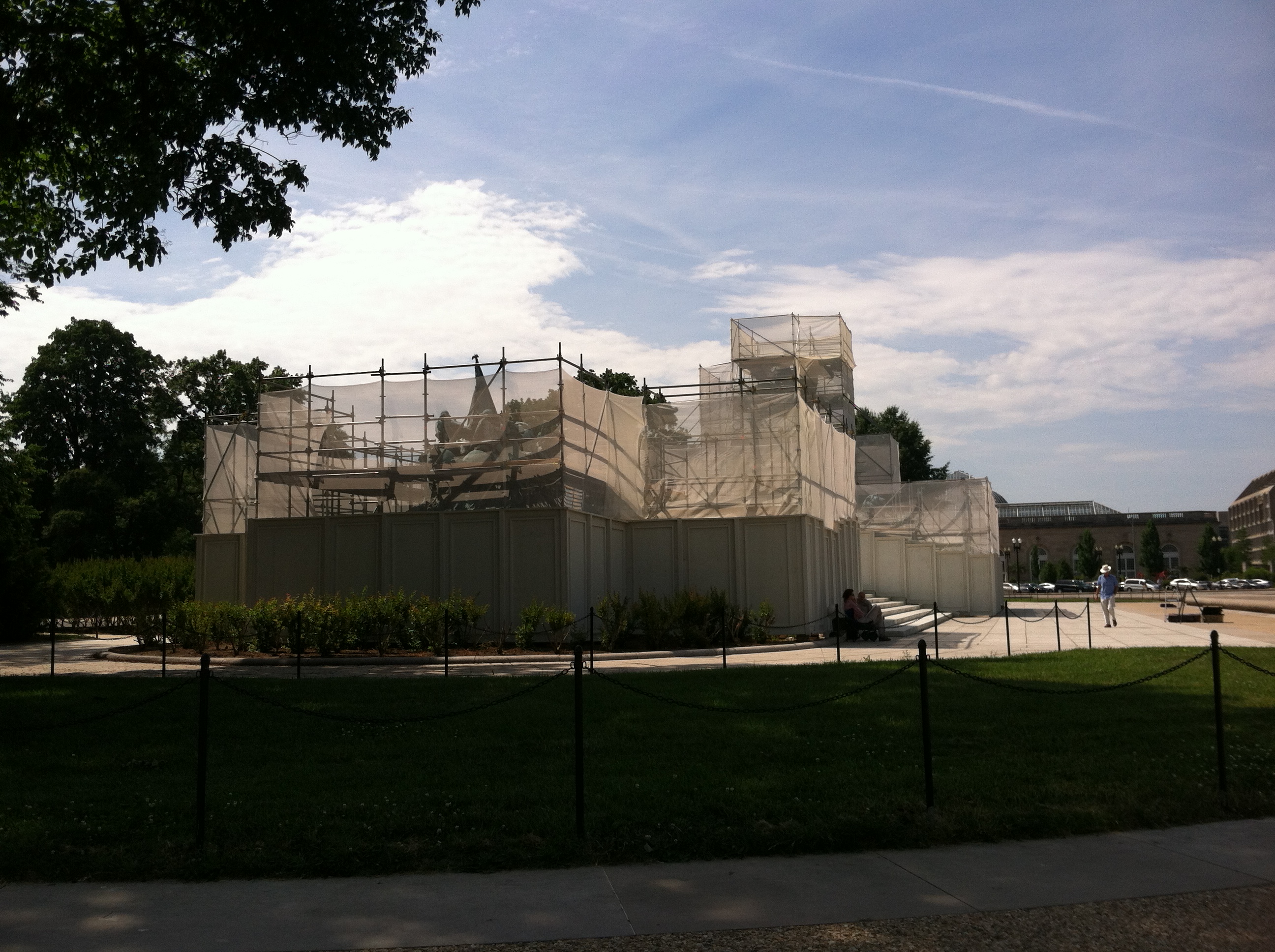
Yesterday I took the bus down to Washington, DC to give a guest lecture in Jennifer van Horn’s summer class, “Art and Myth of the Old South,” co-sponsored by George Mason University and the Smithsonian Institution. As I was walking from Union Station to the Ripley Center, I decided to take a small detour to visit my favorite equestrian monument of all time, the statue of Ulysses S. Grant sculpted by Henry Merwin Shrady as part of the 1922 memorial placed in front of the U.S. Capitol. But when I got there, I found the monument completely shrouded in scaffolding!
It seems that the Architect of the Capitol has undertaken conservation efforts to restore the appearance of the entire memorial, which has fallen into disrepair in recent decades due to exposure to the elements and acts of vandalism. I am so glad to know this is happening, as I’ve been thinking for years that this wonderful work of memorial sculpture is in sore need of attention.
Last weekend I took a trip out to Gettysburg to stay for a few nights. My main purpose was to collect a series of tourist objects to use as examples for group work when my Civil War class discusses souvenirs and tourism in a few weeks. But Gettysburg is also one of my favorite places to visit, and it soothed my soul to spend a few lovely spring days there after a long winter and a hectic semester. I’ve visited the battlefield many times before, so there was no pressure this time to see every aspect of the historical narrative. Instead, I wandered the field with my camera, recording just a few aspects of the site’s monuments and memory. Here are a few examples of what I saw:
Monument to Maj. Gen. Oliver Otis Howard
This monument to Major General Oliver Otis Howard, located on East Cemetery Hill, was sculpted by Robert Aitken and erected in 1932. It clearly depicts the empty sleeve of the general who lost his right arm at the battle of Fair Oaks in June 1862.
Name plaques on the Pennsylvania Monument
I have often climbed to the top of the State of Pennsylvania Monument on Cemetery Ridge, but this was the first time I noticed that the plaques on the monument’s base listing the names of Pennsylvania soldiers who fought in the battle include numerous examples of names erased or added later. This palimpsest of military remembrance speaks to the incomplete record-keeping of the Civil War area and the impossibility of ever having a complete reckoning of the war to set in bronze. And yet, we try.
View from Little Round Top, with statue of Maj. Gen. Gouverneur K. Warren
In the height of summer, it is almost impossible to find a quiet moment to enjoy the view from Little Round Top, but around 5 in the afternoon on Sunday, April 12, we found the hill almost deserted. Karl Gerhardt’sstatue of Gen. Warren always serves as an excellent focal point for the view.
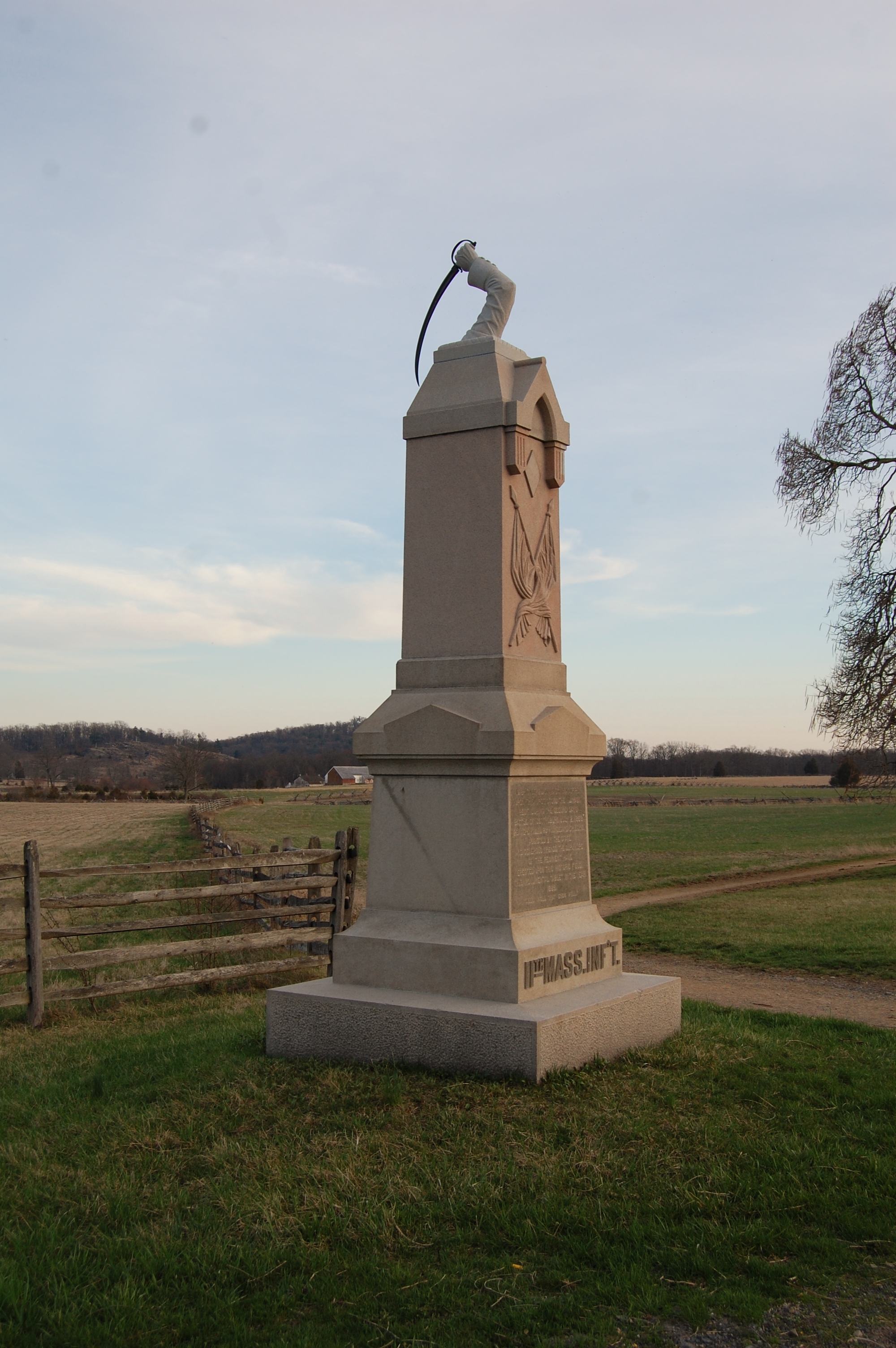
11th Massachusetts Monument
And on our way back into town along the Emmitsburg Road, we spotted the 11th Massachusetts Monument. This monument looks strange to most eyes, but the arm sprouting from the top was one of the key elements of the Massachusetts coat of arms, worn on the buttons of the state’s soldiers. The monument was vandalized in 2006 and painstakingly restored by the National Park Service.
And what of the souvenirs I collected for my Civil War class?
Assorted souvenirs from Gettysburg
My loot included:
A teddy bear wearing the uniform of a Union soldier
A Gettysburg souvenir spoon
A cup and ball game painted to look like a Confederate soldier
A mouse pad alluding to Gettysburg’s recent interest in ghost tourism
A shadow box containing a photograph of Col. Joshua Lawrence Chamberlain and two Minié balls
An Abraham Lincoln salt and pepper shaker set (one shaker is Abe’s head, and the other is his hat)
When teaching a course in art history, material culture, or visual culture, it is desirable to teach directly from the object whenever circumstances and class sizes make that possible. PowerPoint is a terrific tool, but the reproduced image on the projector screen can distort students’ perceptions about size, color, and many other variables. In order to facilitate learning about nineteenth-century visual technologies, I have begun to gather a small teaching collection of photographic materials. The objects in this collection are commonly available in antique stores and on eBay, and run from a few dollars to about $50. In examining these objects up close, students learn to distinguish between different types of photographic processes and experience the intimate scale of these items firsthand.
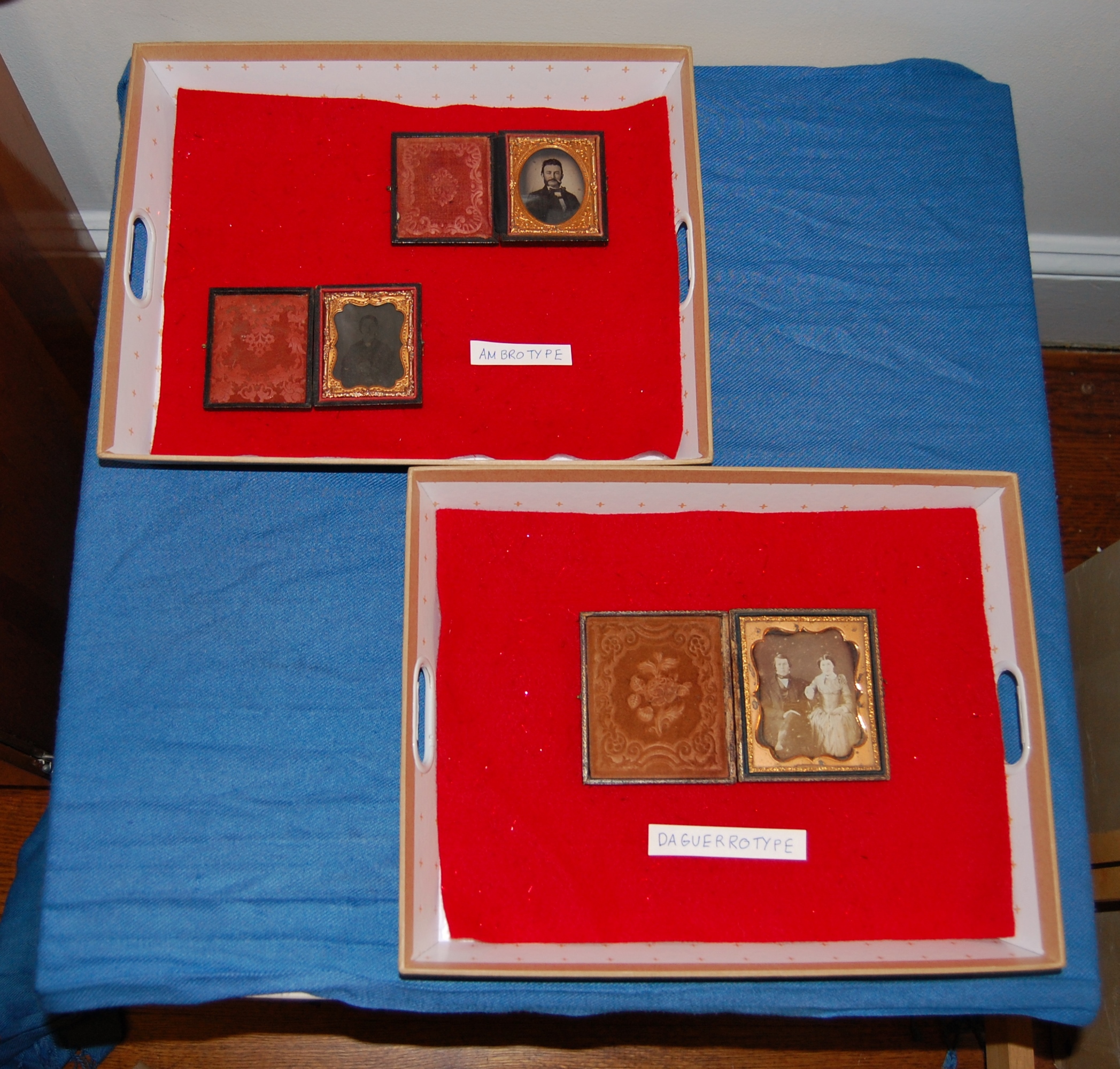
One of the goals of my collection is to teach students to distinguish between daguerreotypes, ambrotypes, and tintypes. These three photographic processes look almost identical when viewed in reproductions in scholarly texts or museum catalogues. But when looking at the photographs in person, students can easily see the differences between the daguerreotype’s mirrored surface, the ambrotype’s black-backed glass, and the tintype’s comparative durability. Students also react to the intimate scale of the photographs in their decorative leather cases.
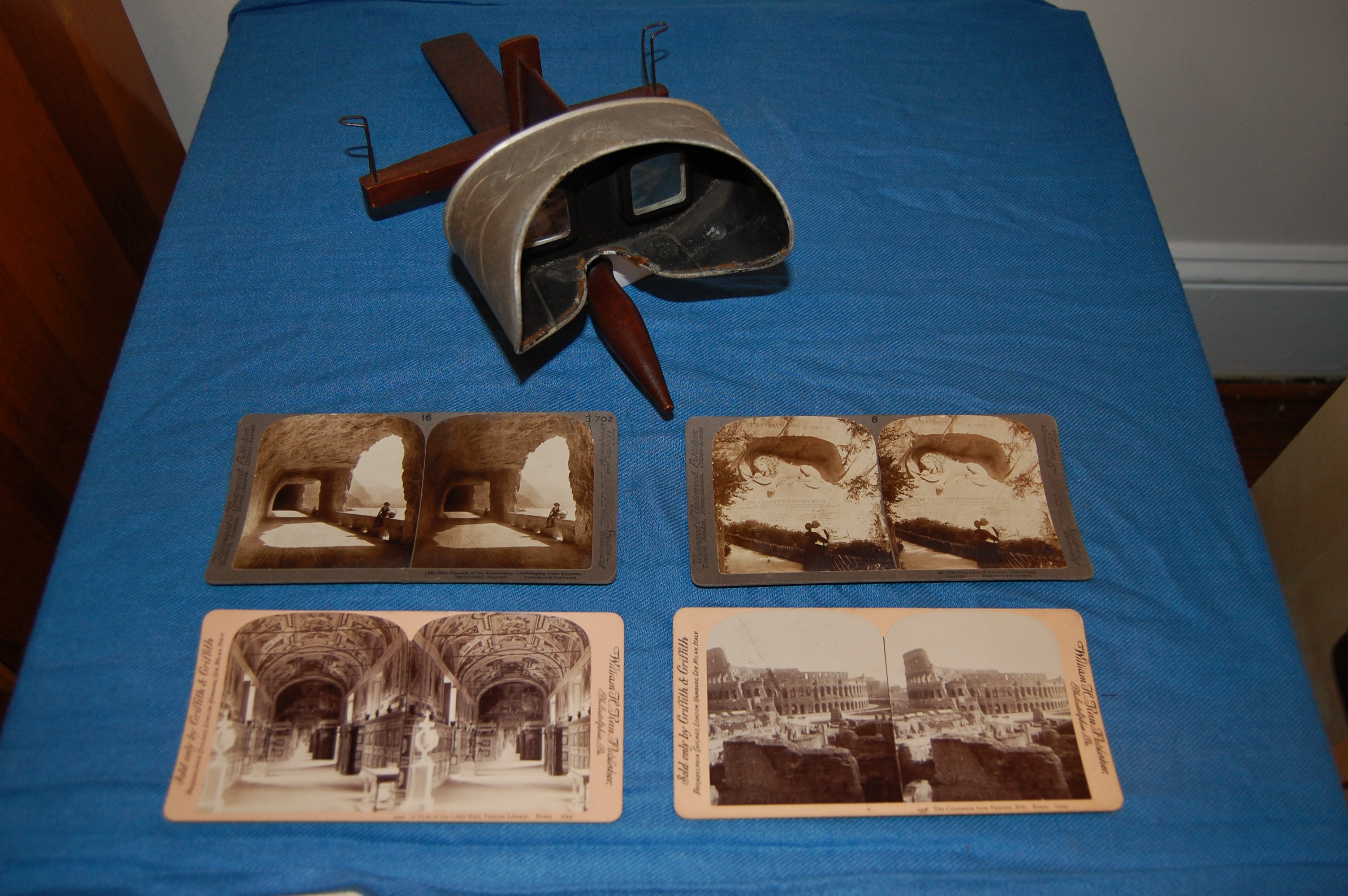
This collection also allows me to let students experience the effect of looking through a stereoscope and seeing a two-dimensional image take on added depth. For classroom purposes, I look for stereo cards with an exceptional depth of field.
For classroom handling, I place the more delicate pieces into letter trays I purchased for a low price at Target. The trays are lined with felt to protect and offset the photographs, and I also place labels in the trays to reinforce the distinction between different photographic processes. These trays allow students to pass the photographs from person to person with a minimal risk of damage.
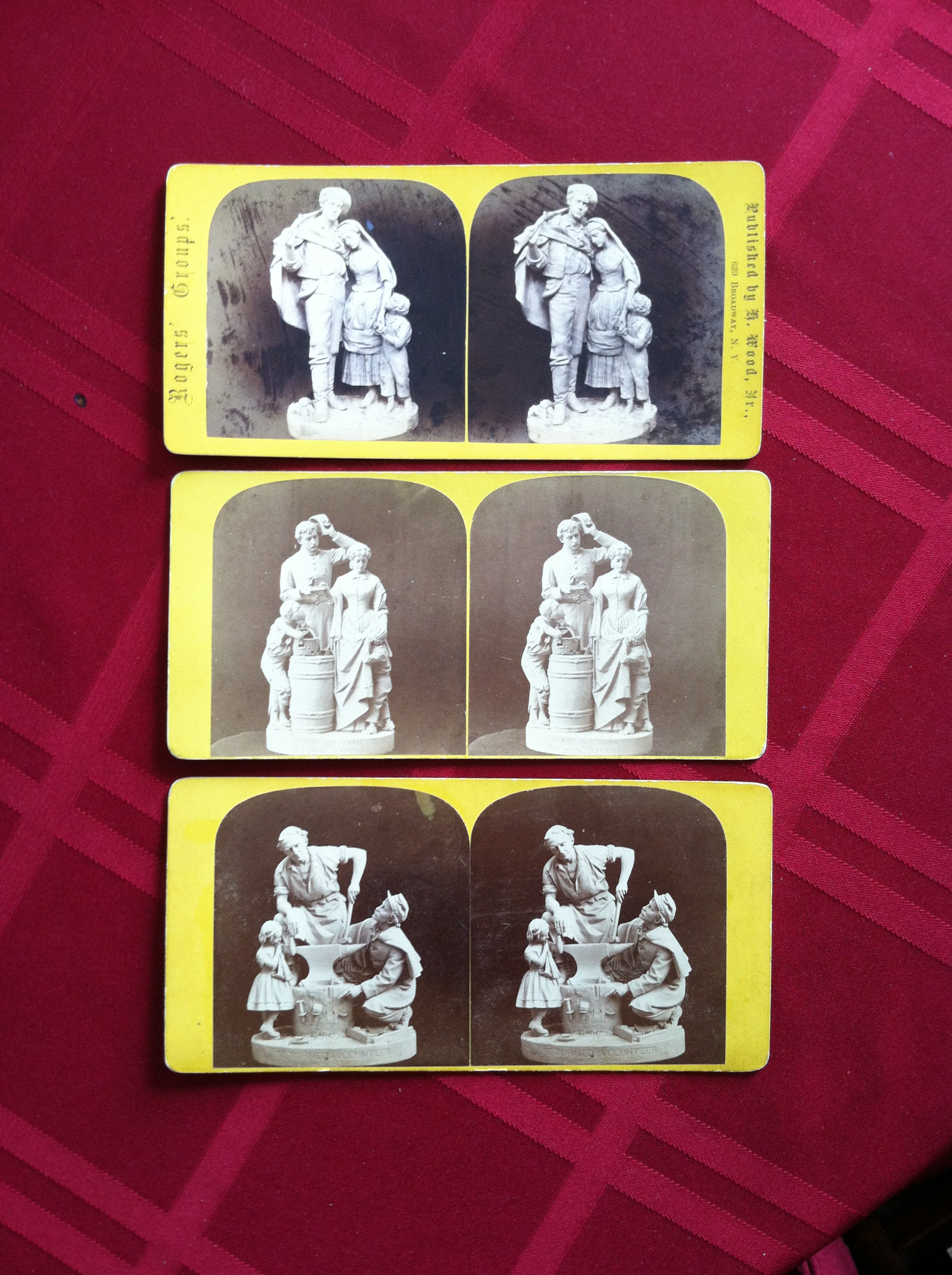
I often look for opportunities to add new categories to my collection. I am particularly interested in the ways in which the stereoscope may have allowed a special understanding of three-dimensional sculpture, and I am looking to collect more sculpture stereo cards. These three cards represent works by John Rogers. In addition, I am hoping to collect CDVs of nineteenth-century celebrities and examples of popular print culture.
One of my favorite objects is this CDV of Sgt. Alfred Stratton of the 147th New York Infantry, who lost both of his arms above the elbow when he was hit by a solid shot outside Petersburg, Virginia on June 18, 1864. After the war ended, he sold CDVs of his image to support his family. I have recently begun investigating Sgt. Stratton’s self-presentation for an article project.
Finally, I remind students that some photographers are still using nineteenth-century processes to produce photographs with an uncanny connection to the past. This tintype (and accompanying CDV) was taken by Rob Gibson of Gettysburg on July 2, 2013 during the celebration of the battle’s sesquicentennial. I find that the video below of Gibson making a wet plate photograph is a useful companion to the presentation of my teaching collection.
I hope this post inspires you to create a teaching collection of your own! Many examples of nineteenth-century ephemera are relatively easy to find and inexpensive to acquire, and a demonstration with actual objects is a valuable tool in the classroom.








 Sarah Beetham, Ph.D.