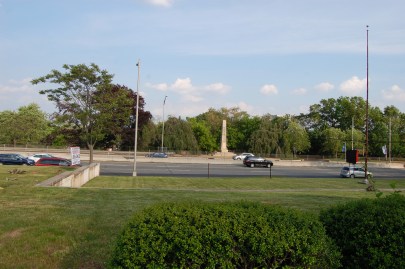
 Last week, I published a blog post about a mysterious abandoned monument on the northbound side of Route 1 in New Brunswick, NJ. The monument is a dilapidated granite obelisk in an overgrown clearing just before the Morris Goodkind Bridge spans the Raritan River, accessible only by snaking along a narrow path right on the edge of the highway. It is missing almost all of its identifying inscriptions, with only the haunting legend “THEIR BODIES REST” carved into the rectangular slab at the base of the obelisk. The monument initially caught my attention as a paradoxical memory space, a memorial that has forgotten the reason for its existence. At the end of my last post, I vowed to find out more about how this site came to be, and I have spent much of the last week thinking about it.
But it appears that I was not the only one intrigued by this monument’s story! Last week’s post was one of the most widely read of any that I have posted so far on this blog, and it seems that many of you are also hungry for more information. And as of today, I have much to report, thanks to the assistance of Dr. Robert Belvin, Director of the New Brunswick Free Public Library, who contacted me last week to share what he knew about the monument. Special thanks also go to my father, Donald Beetham, who spent a lot of time poring over old maps to figure out the early history of Route 1.
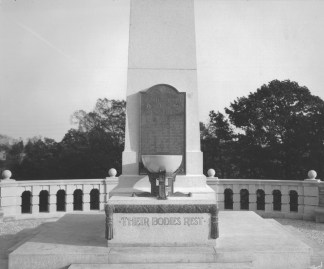
World War I memorial photographed by George Pound (courtesy of Robert Belvin)
I can now reveal that the monument is a World War I memorial, dedicated on October 13, 1930 in conjunction with the celebration of the city of New Brunswick’s 250th anniversary. The architect was Alexander Merchant, and he worked with designer George B. Howell and sculptor F. Luis Mora. Originally, the obelisk bore a plaque listing the names of 74 New Brunswick soldiers who died in the war. The names were placed below the inscription “THEIR SPIRIT LIVES IN LIGHT.” This completes the thought remaining on the memorial today that has so haunted me: “THEIR BODIES REST” is carved upon a stone meant to represent a sarcophagus (once decorated with bronze swags), while the plaque bearing the names would once have represented an upper register in which the names of the fallen could live on. The tablet was once illuminated by a beam of light emitting from a cast bowl meant to symbolize the “cup of life.” This bowl was missing by 1979, when the Home News published an article decrying the dilapidated state of the monument. The area across the highway that I noticed on my visit to the monument last week was originally laid out as a parking area for visitors – which means that the planners intended for pedestrians to cross Route 1! I don’t think I’ll be attempting that anytime soon.
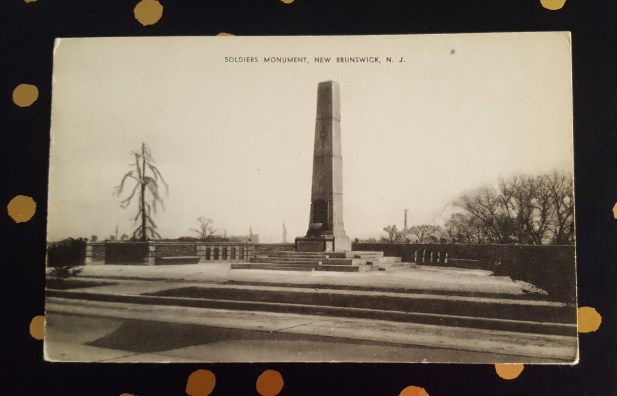
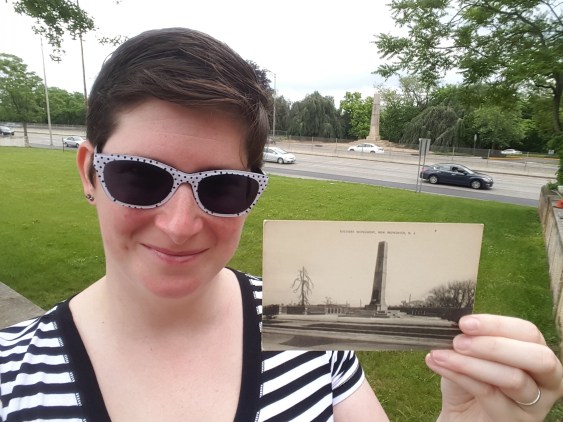
Postcard depicting the monument as it once appeared, acquired from eBay (Author’s collection)
I was able to confirm much of the information I learned about the monument’s original appearance with a postcard that I acquired from eBay that shows the obelisk with all of its original decoration intact. The seller listed this postcard as dated 1910, but there is no date on the card, and as I now know for certain that the monument was erected in 1930, I know that the listing date is impossible. Once again, a reminder to treat all eBay purchases of antique material with a healthy degree of skepticism!
 So what happened in the nearly fifty years between the monument’s dedication and the 1979 article in the Home News decrying its dilapidated condition? I don’t have any direct evidence yet, but I can speculate. Route 1 is a major north-south highway that runs from Key West, Florida, to Fort Kent, Maine (I once visited Mile 0 of Route 1 in Key West!). Its predecessor was the Atlantic Highway, an auto trail laid out in 1911 that was marked as Route 1 beginning in 1922. The current path of Route 1 through New Brunswick was not possible until 1929, with the completion of the College Bridge, now known as the Morris Goodkind Bridge after its designer. Before the completion of the bridge, this part of New Brunswick was mostly farmland, and a spot along the new highway must have seemed a prime location for residents seeking a site for their World War I monument. Clearly, no one making decisions about the monument at that time predicted the high-speed superhighway that Route 1 would become. This tension between vehicular traffic and monumental siting has become increasingly prominent in the last several decades, as monuments placed in traffic circles and at major intersections have proved to be an obstacle to the pace of modern cars. This juxtaposition is dangerous for the monuments, also, as many memorials are brought down every year due to motor vehicle collisions. In the case of the Route 1 monument, it seems that this site became more and more isolated as the highway widened and cars picked up speed, making it inaccessible to most visitors and ripe for mischief and vandalism.
 This is the most likely explanation for the monument’s current state. But thanks to information provided by Robert Belvin, I now know that the monument’s original function as a memorial to the dead of World War I has not been entirely lost. In 2000, Belvin was involved in an effort to rehabilitate the memorial’s bronze plaque and to give it a new home in a space where it is accessible to visitors. The new site is in the center of downtown New Brunswick, where Jersey Avenue splits off from Route 27 (French Street), creating a triangular park. Here, the plaque has been placed on a columnar monument that recalls the original obelisk still moldering on Route 1. The shaft is carved with the same torch an wreath also present on the first version of the monument. And beneath the plaque is a rectangular base carved with the words “THEIR BODIES REST”: thus, the full verse, “THEIR BODIES REST / THEIR SPIRIT LIVES IN LIGHT” is reunited.
 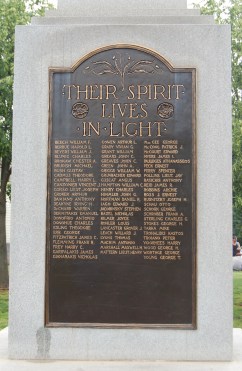 On the rear of the monument is an additional plaque dedicated to the memory of veterans of subsequent American wars. The plaque has been cleaned and repatinated, and the names of the fallen are once again clearly visible. And the park itself is a bustling hub of activity, a major site for workers’ transportation in and out of the city. If many of these passersby do not necessarily have war memory on their minds – then indeed, in its new site, this memorial plaque faces many of the same challenges of war memorials in town centers across the United States. The memory of these particular soldiers is no longer marooned by highway activity, but instead left to compete for the divided attention of today’s citizens. This is the fate of most war memorials under ordinary circumstances.
But the Route 1 monument retains it emotional pull. Originally dedicated with great fanfare, the site has been so thoroughly stranded by the highway that the decision was ultimately made to abandon it rather than to attempt to rehabilitate it. With the removal of the inscription and plaque to a new location and a replacement column, the memorial function of this site has been transferred elsewhere. Left behind, the obelisk is a haunting relic, a palimpsest of lost hopes and intentions, an anti-monument. And yet, its crumbling stones continue to tug at the mind.
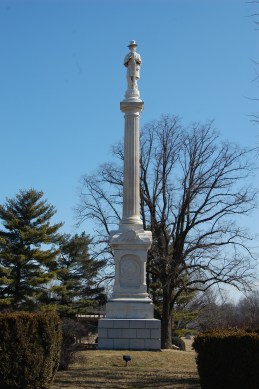 Another one of my academic publications is finally seeing the light of day! In the latest issue of Public Art Dialogue, released over the weekend, you will find “From Spray Cans to Minivans: Contesting the Legacy of Confederate Soldier Monuments in the Era of ‘Black Lives Matter'”, an article I drafted last summer on the controversy surrounding Confederate monuments in the wake of the tragic shooting in Charleston. The article is part of a special issue of the journal titled “The Dilemma of Public Art’s Permanence,” organized and edited by Erika Doss to explore the afterlives of public artworks in a sphere of ever-changing public opinion. The special issue was inspired by a panel at the College Art Association in 2014, in which I participated. When the Charleston shooting brought the continuing existence of Confederate monuments to the forefront of public consciousness last summer, I already had the existence of this special issue on my radar, and I was grateful for the opportunity to think through some of the issues surrounding these memorials.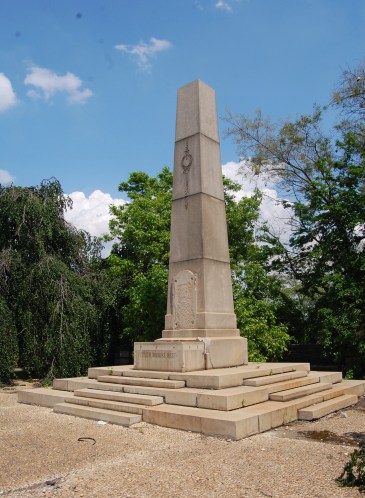


 It is a very old form, dating as far back as ancient Greece, where it was considered a suitable site for philosophical conversations. But during the Roman Empire, the exedra became particularly associated with funerary monuments. Placed alongside major thoroughfares, funerary exedrae offered the weary traveler a chance to sit and to take a break from the dusty road. In return for this courtesy, the traveler might take a moment to read the name of the deceased aloud – because in ancient Rome, a part of a man’s spirit remained alive as long as there was someone to speak his name.

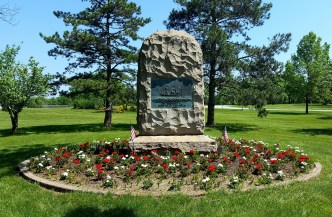 The first stop along my walk today was the Maine Monument, dedicated to three New Brunswick residents who died in the
  The opposite side of the stele features an inscription naming the sailors who perished in the sinking. Also included here is a howitzer captured from the Cabanas Fortress in Havana Harbor during the course of the Spanish-American War. With the inclusion of the howitzer, the monument is part cenotaph and part trophy: naming fallen soldiers whose remains probably lie far from this location, while showcasing an object taken during the course of the military action waged in response to their deaths. This mix of messages is not uncommon in monuments to the Spanish-American War, a war fought entirely overseas for mostly imperial aims that saw eight soldiers perish from disease for every one who succumbed to wounds on the battlefield.
 For this reason, stopping to visit this monument proved to be a fitting beginning for my summer of writing. One of the pieces that I currently have in development concerns Theo Alice Ruggles Kitson’s Hiker, a stalwart bronze soldier of the Spanish-American War first erected in Minneapolis, Minnesota in 1906, and subsequently copied in more than fifty locations across the United States. Created a few crucial years after New Brunswick’s Maine monument, Kitson’s Hiker is a strapping muscle man that embodies all of the war’s triumphs and none of its darker aspects. As I work my way back into this material, I will keep this local monument in mind.
 My visit to the site of the New Brunswick Maine monument yielded one other notable phenomenon. To the left of the memorial to the soldiers of the Maine were two additional markers, one honoring soldiers of Company E of the 114th Infantry, 44th Division of the New Jersey National Guard who fought in World War II, and the other naming several Catholic War Veterans of St. Sebastian Post 405 who perished in World War II and the Korean War. The latter tablet is dated 1958, the year that the Maine monument was relocated from the Court House to Buccleuch Park, and it would be interesting to know more about what led to the relocation of the monument and to the appearance of the additional markers.
  My larger book project, Monumental Crisis: Accident, Vandalism, and the Civil War Citizen Soldier, explores the processes by which monuments are sometimes damaged or altered during the course of their time in public life, whether through accidental or purposeful means. One of the chapters concerns revision, or the series of processes by which a monument or its site may be altered, moved, removed, or amended in order to change its meaning or allow for additional voices to be recognized. In thinking about this series of forces, I often wonder about the ways in which a war memorial honoring the soldiers of one war often begins to attract tributes to veterans of other wars, and how sites in which war in remembered eventually tend to take on multiple meanings and chronologies. I did not necessarily expect to find this particular phenomenon on my walk today, but I was glad for the opportunity to reflect on it.
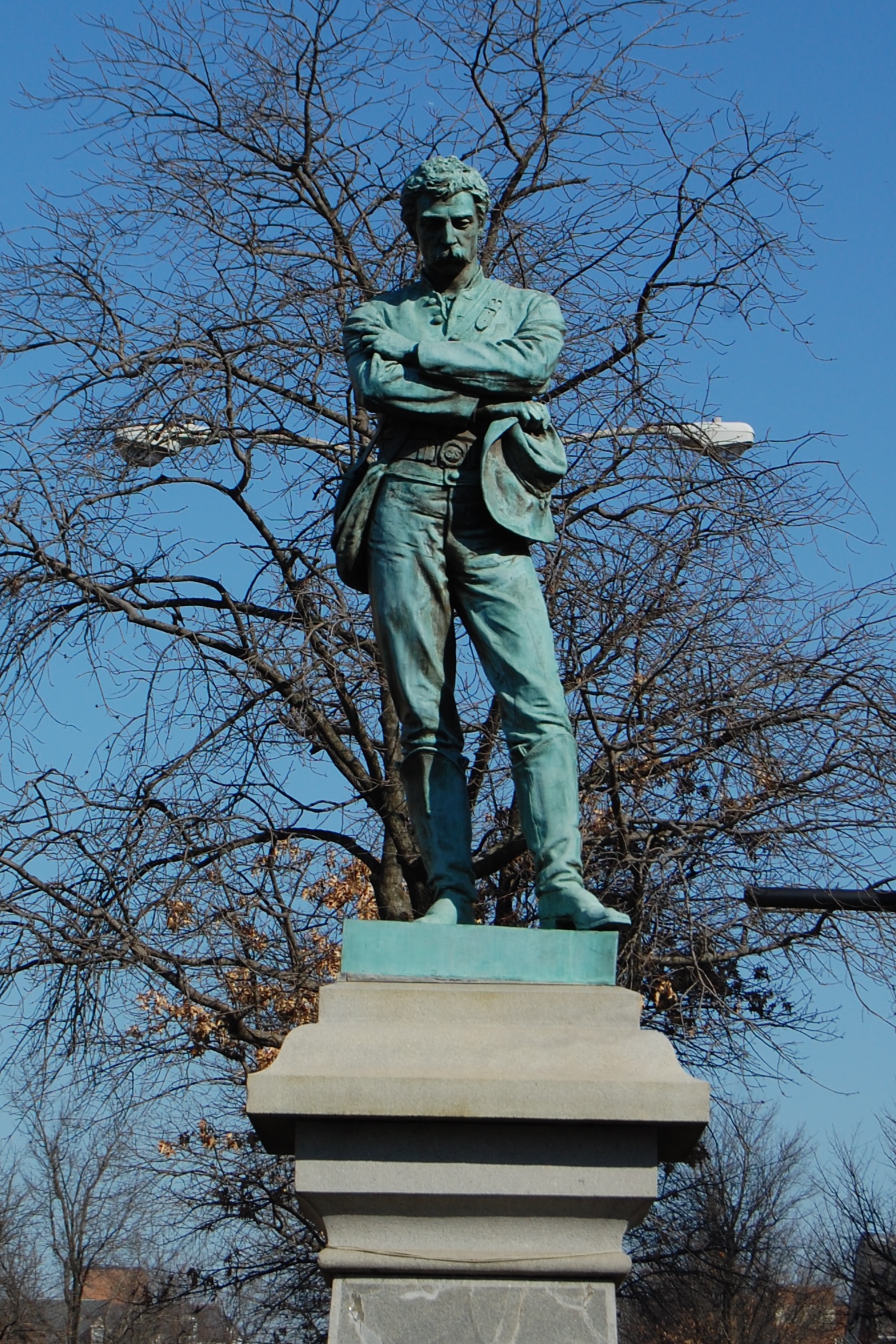
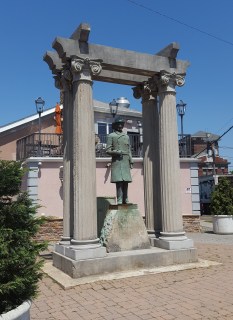 The last monument site I encountered today is in a bit of a different category: the fireman’s memorial. This unusual memorial sits at the corner of Easton Avenue and Wyckoff Street in New Brunswick. Erected in 1931, it consists of a bronze statue of a firefighter displayed underneath a pergola with Corinthian columns. The statue stands atop a rough-hewn granite base carved with the words, “VOLUNTEER / AND EXEMPT FIREMEN / 1747-1941 / ERECTED AD 1931.” At the moment, I do not know any more about the circumstances surrounding this particular monument than I can see in that inscription.
 But I’ve long found firefighters’ memorials intriguing for their potential relationship with the citizen soldier monuments that form the basis of much of my research and writing. Both tend to feature single statues of generic figures meant to stand in for a particular population. Both have at times been mass-produced and sold in catalogues. Both allude to the virtues of self-sacrifice in the service of the good of the community, and as such both serve as didactic exemplars of civic responsibility when placed in public settings. When I think about my bucket list of future research projects, firefighters’ memorials definitely appear on the list, and I would love to learn more about them.
 In fall 2015, I taught the course “Women in American Art” at the Pennsylvania Academy of the Fine Arts. The course examined the contributions of American women artists to the history of art from the late 18th century to the present. For their semester-long project, I asked teams of students to write or improve Wikipedia articles on American women artists in order to increase the visibility of women on that platform. (
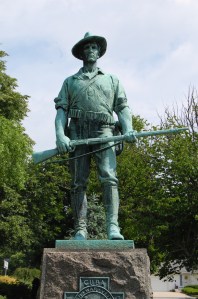 In addition to my teaching responsibilities for the fall, I presented papers at two conferences. In early October, I traveled up to Toronto, ON for the American Studies Association, where I presented “Resorting to Reproduction: The Elbert County Confederate Monument and the Failure of Originality.” This was the first time I ever attended the ASA, and I was impressed with the range of panels of interest to scholars of visual and material culture. Later that month, I headed out to Pittsburgh to attend the Southeastern College Art Conference, one of my favorite events every year and a must for researchers in American art. My paper, “Toward a Manly Ideal: Kitson’s Hiker and the Spanish-American War,” marked the first time I have ever spoken in public about my work on Spanish-American War monuments. One of my goals this summer will be to submit some of that material for publication. At the end of October, I relocated from Delaware to New Jersey – a non-academic activity that took up a tremendous amount of my time!











 Sarah Beetham, Ph.D.